
Noorani Qaida — Online Classes for Children and Adults
The Noorani Qaida is the book almost every Muslim parent will recognise from their own childhood, and it has survived generations for a straightforward reason: it works. It takes someone who cannot read a word of Arabic and, page by page, gets them reading the Quran.
- Female Tutors
- Al-Azhar Experts
- Flexible Schedules
- One-On-One
payment needed · Cancel any time
WHO IT’S FOR
For the child who are starting Arabic from nothing
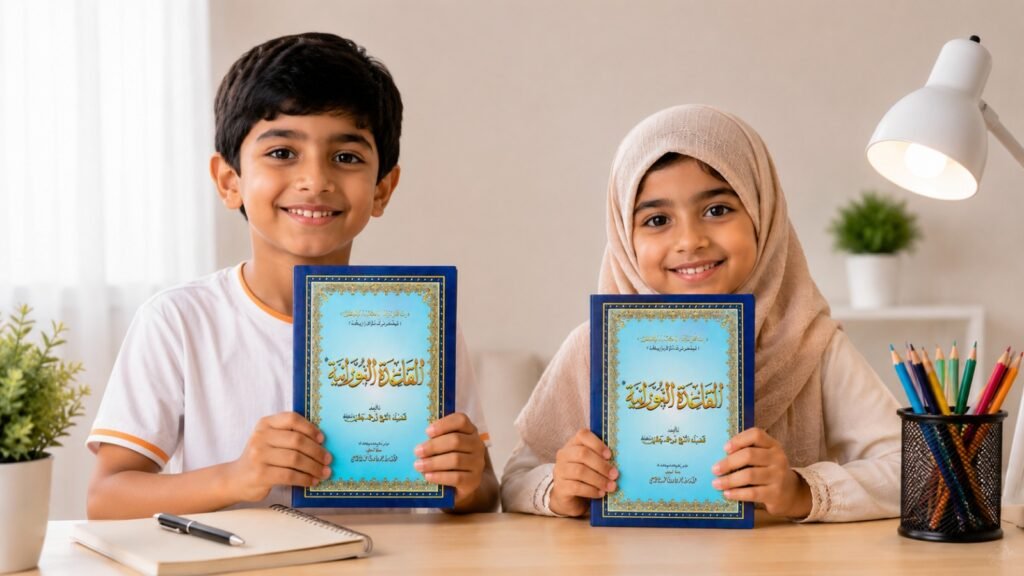
Children from around age four who are starting Arabic from nothing. Adults and reverts who want to read the Quran and have never learned the script. Anyone who was taught to read by ear or from transliteration and needs to go back and build the foundation properly. No prior knowledge at all is assumed.
learn to read . noorani qaida
From the First Letter to the First Page
A clear, patient path from the shapes of the letters to reading the Mushaf itself.
Your teacher moves one step at a time — no stage is skipped, and the sounds English
doesn’t have are given the time they need.
The Letters in Isolation
All 28 letters, by name and by sound — with the sounds English does not have given the time they need.
Letter Forms & Joining
How each letter changes shape at the beginning, middle and end of a word — and reading them joined, not one at a time.
Harakat — Short Vowels
Fatha, kasra and damma — and reading letters with short vowels fluently.
Sukoon & Tanween
Silent letters and the doubled endings — and the rhythm they give to a word.
Madd Letters & Shadda
Lengthening and doubling — counted consistently, not by guesswork.
Reading Practice
Connected words, then short verses, then the first pages of the Mushaf — with the basics of Tajweed introduced by imitation as they arise.
Every lesson is one-to-one. Your teacher listens closely and moves at your child's pace — no step is rushed and none is skipped.
How the Lessons Work
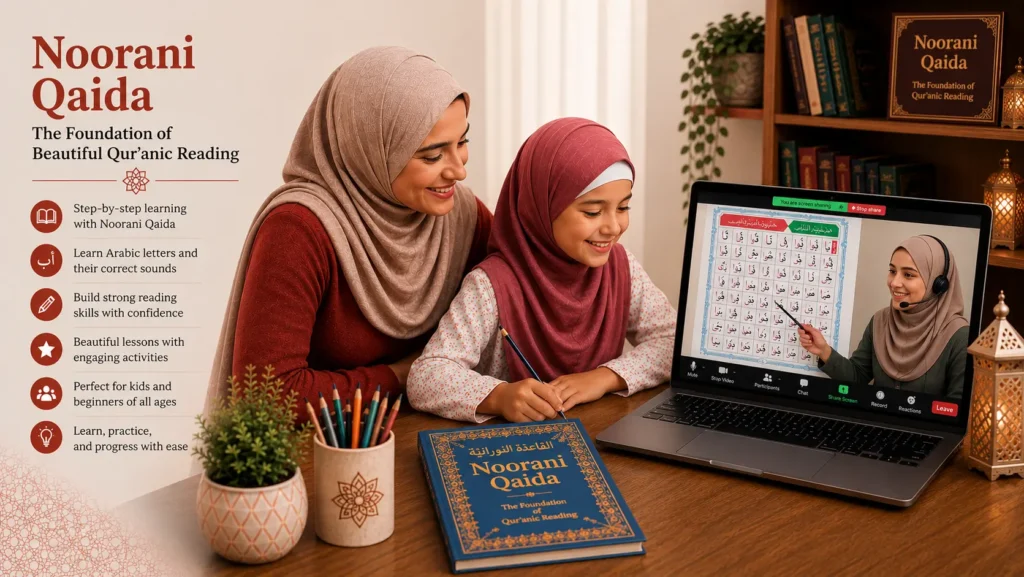
One-to-one over Zoom, with an ijazah-certified teacher. You recite; your teacher listens with the standard set high and corrects at a level of detail you may not have experienced before.
Most students take 45 or 60 minutes, two or three times a week — enough time to work slowly and precisely, without rushing a single letter.
The lesson at a glance
One-to-one on Zoom
With an ijazah-certified teacher — never a group.
45 or 60 minutes
The length most advanced students choose.
2 or 3 times a week
Steady, sustained practice at depth.
Correction at fine detail
The standard held high, every lesson.
Progress here is slower and more demanding than in the beginners' course — and that is the point.
WHAT’S INCLUDED
Everything your child needs to succeed
New memorisation + revision
A proven two-part system so what they learn stays.

Memorised with Tajweed
Correct pronunciation built in from the very start.

Al-Azhar teachers
Qualified, Ijazah-holding, female or male.

Monthly reports
See exactly how your child is progressing.
Flexible times
30, 45 or 60-minute lessons around school.

Free trial first
Start from £30/month — no payment to begin.
Frequently Asked Questions
How long does the Noorani Qaida take?
Most children finish in three to six months at two or three lessons a week. Adults often do it faster. The pace matters far less than the accuracy of the sounds learned along the way.
My child is four. Is that too young?
Four is fine if the lessons are short and playful, which is how we teach at that age. If your child isn’t ready, your teacher will say so honestly after the trial rather than take your money for a year of nothing.
Should we choose Noorani Qaida or Noor Al-Bayaan?
Both work and both get to the same place. The Qaida is the classic; Noor Al-Bayaan is more tightly sequenced with more built-in practice, and often suits younger children better. Your teacher will recommend one after the trial lesson, and we switch if it isn’t working.
Do we need to buy the book?
No. We share it on screen during the lesson, and we’ll send you a copy you can print if you’d like to practise between lessons.
Related courses
Quran Recitation
Reading the Mushaf fluently and correctly, with every letter corrected as it is read. For students who can already manage the Arabic script and want their recitation to become smooth, accurate and confident.
Tajweed for Beginners
The rules of correct recitation, introduced one at a time and applied straight away: makharij — where each letter is produced — the basic madd, and the noon and meem rules. Nothing is learned as theory before it is used.
Noorani Qaida
The classic first book. Letters, their shapes and sounds, joining them together, and the vowel marks — the foundation everything else rests on. Most children work through it in a few months.