
Islamic History — What Happened Next
This course fills that in, and treats it as history: people, places, dates, causes and consequences, including the periods that were difficult and the decisions that went badly. Children remember history when it is told honestly and as a story.
- Female Tutors
- Al-Azhar Experts
- Flexible Schedules
- One-On-One
payment needed · Cancel any time
WHO IT’S FOR
For the child who can read
Children from around age nine who have covered the Seerah and are ready for what followed. Teenagers studying history at school who would like the half the syllabus leaves out. Adults who know the beginning and the present and very little in between.
The journey, step by step
What You'll Work On
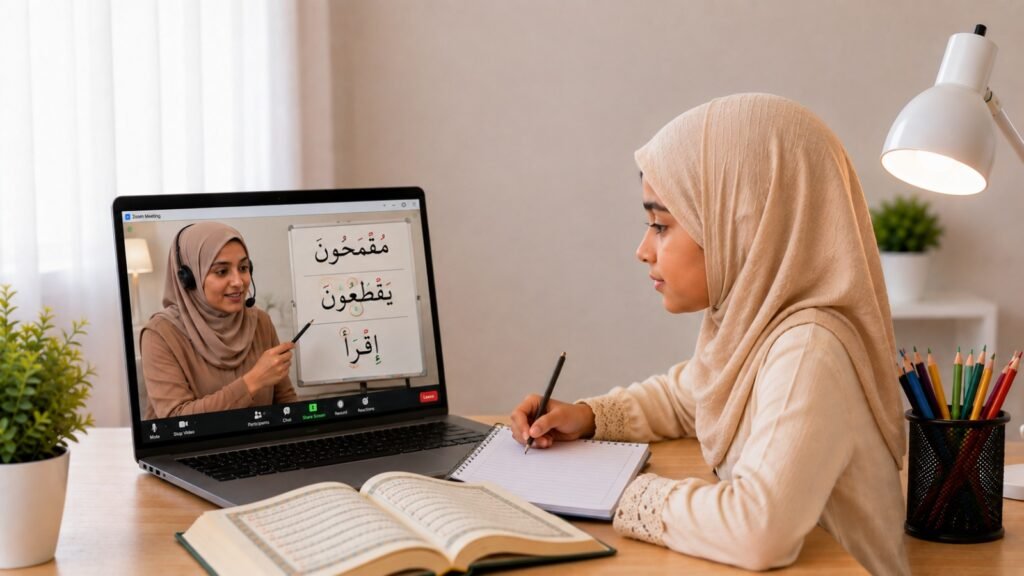
Each stage builds on the one before it — from reading the letters cleanly all the way to reciting beautifully.
Fluency in the script
Reading without hesitating over letter shapes, so your attention is free for accuracy rather than decoding.
Accuracy of the letters
The letters English speakers habitually merge, corrected one at a time: the two h's, s's, d's, t's, and the ‘ayn that usually disappears altogether.
Applying Tajweed while reading
The rules you know in theory becoming automatic in practice — a different skill from learning them, and one that takes longer.
Pace and breath
Where to stop, where not to, and how to read at a speed that lets you pronounce everything properly instead of racing to the end.
Beauty
Once accuracy is secure: the tone, the pauses and the melody that make recitation something people want to listen to.
WHAT’S INCLUDED
Everything your child needs to succeed
New memorisation + revision
A proven two-part system so what they learn stays.

Memorised with Tajweed
Correct pronunciation built in from the very start.

Al-Azhar teachers
Qualified, Ijazah-holding, female or male.

Monthly reports
See exactly how your child is progressing.
Flexible times
30, 45 or 60-minute lessons around school.

Free trial first
Start from £30/month — no payment to begin.
Frequently Asked Questions
What age is this suitable for?
Around nine and up. Younger children usually get more from the Seerah first, since it gives them the starting point everything else follows from.
How long is the course?
Roughly a year at one lesson a week to cover all six periods. It can be shortened by focusing on a particular era.
Do you cover the difficult parts of the history?
Yes. Conflicts, mistakes and periods of decline are part of the account. A sanitised history is not history and children see through it quickly.
Can this help with school history?
Often, yes — particularly the crusades, the Ottomans and the colonial period, which appear on UK syllabuses and are usually taught from one side only.
Related courses
Most children pick up the Seerah as a scattering of episodes: the cave, the migration, a battle whose name they half remember. Told that way it never becomes a story, and a story is exactly what it is.
Children ask the hard questions early, and usually at inconvenient moments. Where is Allah. Why can’t we see Him. What happens when we die. Answered badly, those questions leave a residue that lasts years.
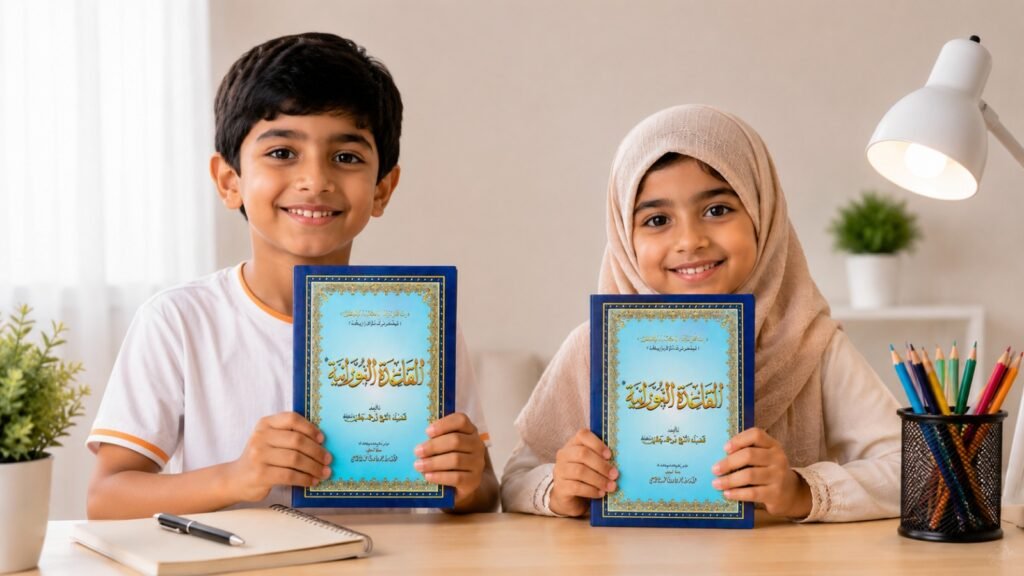
The classic first book. Letters, their shapes and sounds, joining them together, and the vowel marks — the foundation everything else rests on. Most children work through it in a few months.